
Read Per Herngren’s whole book on Internet: Path of Resistance The practice of Civil disobedience (214p)
Book Review
Path of Resistance: The Practice of Civil Disobedience
by Per Herngren
Reviewer: David Westby published in Social Anarchism 1996 #22
This book is the product of its author’s reflections on and research into his and others’ experiences in peace movement activities in Scandinavia, the U.S. and elsewhere. Herngren is a sociologically-trained Swede, and above all a lifelong peace movement activist. In the U.S., in consequence of participating with others in a Plowshares missile-disarming action in 1984, and after being convicted, he served 18 months (mostly) in Danbury prison. In Sweden he was one of the organizers of Swedish Plowshares, which has mounted a series of actions against Swedish weapons exports mainly (by Bofors) and continued development of the JAS 39 Gripen high-tech fighter plane by Saab-Scania. The most important of these, and certainly the largest action ever mounted by Plowshares, was a four-weeklong “peace camp” at the Saab-Scania compound near Linkoping attempting to shut down further development of JAS, in which hundreds participated. Along with his own engagement in the peace movement, Herngren has worked over several years assembling accounts of the experiences of others, particularly but not exclusively, those engaging in civil disobedience. He knows whereof he speaks, and is as qualified as anyone to take on the subject. Path of Resistance is technically a manual detailing how to do civil resistance, but one that goes well beyond others in its scope, objectivity and critical perspective. Herngren says that his purpose was “to get recent experience in nonviolence down on paper” (p. 3). I think the book will be very useful not only for those engaged in civil disobedience along with other movement people, but for a great many others, as well. The bulk of it is a very practical and detailed account of when and how to do civil disobedience, along with plenty of real-life accounts, particularly having to do with Plowshares and the sanctuary movement. There are detailed, critical-minded discussions of affinity groups, problems of security, the various kinds of actions (among them camps, destruction of weapons, sabotage, and monkeywrenching), how to manage the trial and punishment, and more. In all this there are no sacred cows and no hallowed beliefs or practices. To mention just one example, Herngren professes astonishment at the widespread mounting of blockades, and goes on to present a solid critique.
Path of Resistance, however, is a good deal more than just a how-to-do-it handbook. Civil disobedience is subjected to a theoretical and practical critique that establishes its possibilities and limits. It is one method among others, neither inherently better or worse then others, but one to be employed when appropriate. Herngren’s conception will probably contain some surprises for many readers. Its basic purpose is to establish dialogue with the opponent, a dialogue which is to be maintained indefinitely. Resistance to authorities, which may take the form of civil disobedience–but other forms as well–forces a reaction from the opponent, which is then drawn into dialogue. This may be a gradual process in which actions are escalated, and in which the dialogue will hopefully expand to include other officials, citizens, and indeed, the entire society.
This escalation necessarily involves the trial and punishment as elements of the resistance. The point, according to Herngren, is not to influence public opinion, but to challenge others to enact disobedience. The trial provides opportunity to institute a dialogue. The willingness to submit to punishment demonstrates that the resister is prepared to accept the consequences of his or her actions; it counters the fear that all must overcome to engage in civil disobedience.
Because establishment of dialogue presupposes a moral grounding, resistance aimed at establishing it must proceed nonviolently. Any forms of resistance that encourage violence on anyone’s part are rejected out of hand: certain types of direct action, in Herngren’s view, fall into this category. Nonviolence is not, on this view, grounded in religious or other absolutist ideological foundations. Indeed, Herngren claims that civil disobedience has grown out of humanist and liberal traditions (p. 6), but makes no mention of its well-known religious sources. He finds the fulcrum of resistance not so much in the individual conscience as in the community of resisters, and rejects the idea, fostered by Martin Luther King, Jr., of civil disobedience as self-purification, maintaining that this sets up an elitist distinction between a self-styled movement elect and others unable or unwilling to purify themselves.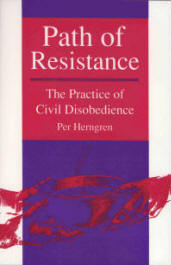
Most fundamental, if resistance is to be mounted effectively and in accord with these stipulations, it must be grounded democratically. For Herngren, democracy “is based on the assumption that all parties involved come to an agreement, and “resistance should be based on the conditions for democracy” (p.12), as much a Swedish doctrine as one of recent participatory democracy. I will not here attempt to relate the ways in which this conception informs the details of Herngren’s discussion, but only say that, to my mind, it is generally well argued and convincing.
I think there are a few logical difficulties on the theoretical and conceptual side of Herngren’s argument. For example, the attempt to distinguish civil disobedience from direct action is clumsy and to some degree self-contradictory. But these are minor flaws in an otherwise exemplary text. It can be profitably read by both those within and outside the movement.
Reference
Path of Resistance: the Practice of Civil Disobedience by Per Herngren. Translated by Margaret Rainey. 214 pp. Philadelphia: New Society Publishers, 1993. $14.95 paper.